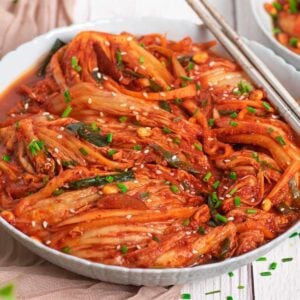
Traditional Cabbage Kimchi Recipe (배추김치)
A complete guide to making authentic cabbage kimchi recipe (배추김치). Spicy, sweet and with a umami flavour, this kimchi unique and delicious!
Equipment
- 2 10 quart plastic bowls for salting the cabbage
- 1 5 quart mixing bowl for mixing the kimchi paste
- 1 small saucepan for making rice porridge
- 1 food safe gloves
- 1 blender or food processor
- 1-2 large fermenting dish or Korean Onggi at least 2 gallons
Ingredients
Fresh Vegetables
- 2-3 large Korean (or Napa) cabbages (8-9 pounds or 4 kilograms)
- 3 cups Korean radish or daikon, julienned
- 1 ½ cups carrots, julienned
- 4-5 large green onions, chopped
- 1 ½ cups Asian chives
- 1 ½ cups dropwort (minari), optional
- ¾ cup Kosher salt (coarse), for the cabbage
Anchovy broth
- 3 ½ cups water (875 grams)
- 1 green onion
- 5-6 dries frozen anchovies '마른멸치'
- ½ large onion, cut into quarters
- 3-4 sheets dried kelp seaweed
Rice porridge
- 3 cups anchovy broth or water * (750 grams)
- 3 tablespoons sweet rice flour '찹쌀 가루' (25 grams)
- 2 ½ tablespoons brown sugar (35 grams)
Kimchi paste
- 2 ½ - 3 cups gochugaru Korean pepper flakes, coarse * (250-300 grams)
- 3 tablespoons anchovy fish sauce
- 6 tablespoons saeujeot '새우젓' fermented salted shrimp
- ½ large Korean pear, pureed
- 3 large garlic heads, pureed
- 3 rablespoons ginger, pureed
- 2 tablespoons runny honey (40 grams)
- 6-8 dried raw jujube dates
- ¼ cup pine nuts, optional
Instructions
Salting the cabbage
- Cut all the Napa cabbages into halves length-wise. Cut the stem of each half about 2 inches from the bottom, ensuring the leaves are still attached to the stem.
- In a large bowl, add the same amount of water as the cabbage and 1/10th salt. Mix well, then add the cabbage into the brine solution. Let salt for 30 minutes.
- Separate each layer of cabbage leaves, then sprinkle salt from the stem to the top of the leaf. Ensure to add more salt towards the stem, where the leaves are thicker.
- Set the salted cabbages aside in large bowls, and let them ‘marinate’ for 2 hours. During this time they will produce a lot of liquid. Turn them over every 30-40 minutes, then spoon some of the salty cabbage liquid over to properly coat all sides.
- After 2 hours, wash the cabbages well in cold water. Ensure you remove all salt in between all the layers. Wash the cabbages in clean water a few times, separating each layer to remove the salt completely.
- While cleaning the cabbages, split each half into quarters using the slit made earlier. There’s no need to use a knife, this can be done by hand as the leaves will be very soft.
- Place the cabbages face down on a wire rack to drain all excess water.
Rice Porridge
- Prepare the anchovy stock (skip if using water instead). Add all the ingredients to a large pot and cook over high heat until boiling. Reduce heat to medium and simmer for 30 minutes. Let it cool down slightly.
- Combine lukewarm anchovy stock (or water) and sweet rice flour in a pot. Stir well, then cook over medium heat for 10-12 minutes.
- Once the mixture starts bubbling, reduce heat to medium and add in the sugar. Cook for another 2 minutes whilst stirring continuously to prevent sticking.
- Remove from heat and cool off completely.
Kimchi paste
- Prepare all the ingredients for the seasoning. Place saeujeot, garlic, ginger and Asian pear into a blender or food processor and puree.
- In a medium bowl add the rice porridge, gochugaru, fish sauce, pureed saeujeot and Asian pear, minced garlic and ginger, as well as the honey. Mix well, then let sit for 30 minutes at room temperature.
- After 30 minutes, add the julienned radish and mix well to combine. Let rest for another 30 minutes.
- Afterwards, mix in the julienned carrots, sliced jujubes and pine nuts. If using raw squid, chop it into small pieces and add it in at this stage.
- Lastly, add in the green onions and chives. Mix everything well, then let it rest for 1 hour.
Assembling the kimchi
- Take each cabbage quarter and spread the seasoning mixture between each layer of leaves. Spread the seasoning paste from the stem all the way to the top of the leaves. Ensure each inch of the cabbage is coated in the seasoning paste. Repeat the process for all the remaining cabbage quarters.
- Wrap the outer leaves over the stem and tuck it tightly into a small bundle. Pack each cabbage quarter tightly into the fermenting jar. Press them down so they are nice and snug. Add any remaining seasoning paste on top.
- Seal the fermenting container, then leave at room temperature away from sunlight at 68℉ (20℃) for 24-48 hours. Once the kimchi starts fermenting, bubbles will appear on the surface and the smell will turn sour.
- After fermenting, store kimchi in the fridge in an airtight container. Ensure it's covered by the kimchi paste at all times.
Notes
- Freshly prepared kimchi can be eaten right away, but it tasted better after fermenting.
- When storing, ensure kimchi is submerged under the juices at all times to prevent mould from forming. Add a layer of plastic wrap directly on the surface to prevent any air from entering, then seal airtight container or jar.
- Whilst fermenting, baechu kimchi can turn very salty or bitter, but this is normal. After fermentation is complete, the flavour will stabilise and mature.
- If kimchi is still too salty, place some Korean radish or daikon slices in between the cabbages and ferment for 2-3 days in the fridge.
- Nutritional information is estimative only and is calculated per 1 cup serving.
Nutrition
Calories: 25kcal
Tried this recipe?Let us know how it was!