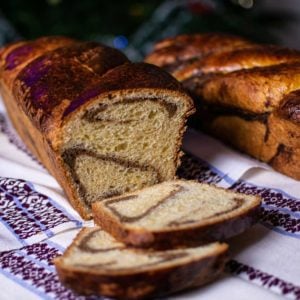
Romanian Cozonac (Cozonac cu nuca)
A traditional Romanian Cozonac filled with lots of walnuts and chocolate. This cozonac tastes like a sweet milk brioche and is best served with warm milk. Typically made on Christmas and Easter, his recipe for 'Cozonac cu nuca' has been passed down in my family through generations.
Equipment
- 2 x brioche trays 30 x 8 cm (12 x 3 inches)
Ingredients
Yeasty starter
- 50 grams fresh yeast*
- 15 grams sugar
The dough
- 1 kilograms cake flour (Type 000)*
- 3 eggs, large
- 3 egg yolks, large
- 250 grams sugar
- 400 grams milk, warm
- 5 grams salt
- 150 grams vegetable oil*
- 1 teaspoons lemon zest
- 1 teaspoons orange zest
Chocolate walnut filling
- 3 egg whites, large
- ½ teaspoons salt
- 150 grams sugar
- 50 grams cocoa powder
- 400 grams walnuts, chopped
- 1 teaspoons rum extract*
- 2 teaspoons orange zest
Extra (for brushing)
- 2 eggs
- 20 grams milk
Instructions
The dough
- First we need to prepare the yeasted dough 'starter'. In a small bowl add the fresh yeast and 1 tablespoon of sugar. Mix with a fork. Add in the warm milk and mix well. Set aside and let rest for 10-15 minutes.
- In a large bowl add the flour, the yeast starter and the milk. Mix to combine loosely with wooden spoon or spatula. (Note: this can also be done in a stand mixer).
- Add the eggs and zest combining in a few stages. The zest will give a wonderful fragrance to your brioche. At this stage, if the dough seems too liquid, add a little more flour - see notes.
- Once incorporated, add in the vegetable oil. Using your well-greased hands, fold over the dough in order to incorporate the fats. This should be done in two stages, only mixing in the second half once the dough has completely absorbed the oil/butter mixture. In order to fold, gently reach under your dough and pull it over, folding it onto itself. Be careful not to rip the dough, and do slow, steady movements.
- Once the fats have been incorporated, cover with cling film and a kitchen towel and place in a warm place to prove. Let prove for 1-2 hours or until it doubles in size.
Chocolate Walnut Filling
- In a large bowl, whip your egg whites with the salt until they become frothy.
- Add in the sugar in stages whipping well, making sure it dissolves into the egg whites. Mix until you reach medium-firm peaks. Add the cocoa powder and mix until fully incorporated.
- Chop the walnuts in a blender or food processor before adding to the mix. Add the chopped walnuts in two stages, mixing with a spatula to gently fold them into the mixture.
Assembling the Cozonac
- Grease your work surface with plenty of vegetable oil. By now your dough should have doubled in size. Gently fold in the dough to deflate a bit of air.
- Using a knife or scraper, divide the dough into 4 equal parts.
- Roll out each piece until you get a fluffy sheet of about 30 x 20cm (12 x 8 inches).
- Using a spatula, cover the dough sheet with your filling, leaving a 5cm edge on one side.
- Start rolling out the dough into a roulade, with the 5cm gap at the end, to help seal the edges.
- To make the final shape of the cozonac, braid two rolls together starting in the middle. Simply overlap sides until you get the desired braid. We don't want the brioche to be too tight, so 2-3 turns on each side should be more than enough.
- Scoop up your dough and place in a well greased brioche tray.
- Set aside and let prove for 30 minutes in a warm place.
Baking the Cozonac
- Pre-heat oven to 180°C (360°F) fan assisted.
- With a fork, quickly whip up the egg yolks with a dash of milk. Using a pastry brush, cover the brioche with the egg wash. This will give a lovely shine to your cozonac.
- Bake for 20 minutes, then cover with some baking paper to prevent the top from burning. Fix the baking paper with some toothpicks to prevent it from moving due to the fan.
- Bake for a further 25 minutes until done. Depending on your oven, you might need more or less time - please check with a skewer to see if they're done.
- Leave the Cozonac in the tray for 5 minutes, then remove and place on a cooling rack on their side. Be sure to turn them every 10 minutes, so they don't lose shape.
- Once cooled, you can cut and serve with a cup of warm milk!
Video
Notes
- I recommend using a kitchen scale in grams for more accuracy. The cups used for the conversion are standard US customary cups (1 cup flour = 136g). There are many different types of cups across the globe, which is why I strongly recommend using grams instead.
- Yeast: Fresh yeast can be replaced with instant dry yeast (50g fresh = 15g dry).
- Flour type: this recipes uses cake flour, also known as type 000 flour (extra fine). This flour can be replaced with plain white flour, however you might need to add 50-100g more than the quantity indicated in the recipe.
- Vegetable oil: use non-flavoured oil, such as sunflower or canola (rapeseed) oil.
- Rum extract: although optional, rum extract adds a wonderful flavour. If you cannot find it, add 1-2 teaspoon of real rum instead.
- Storing: The best way is to wrap it in cling film and store for up to 2 days at room temperature. I will be surprised if they last that long anyway! I wouldn't recommend freezing or keeping in the fridge, as it tends to make the cozonac crumbly.
Nutrition
Calories: 200kcal
Tried this recipe?Let us know how it was!